
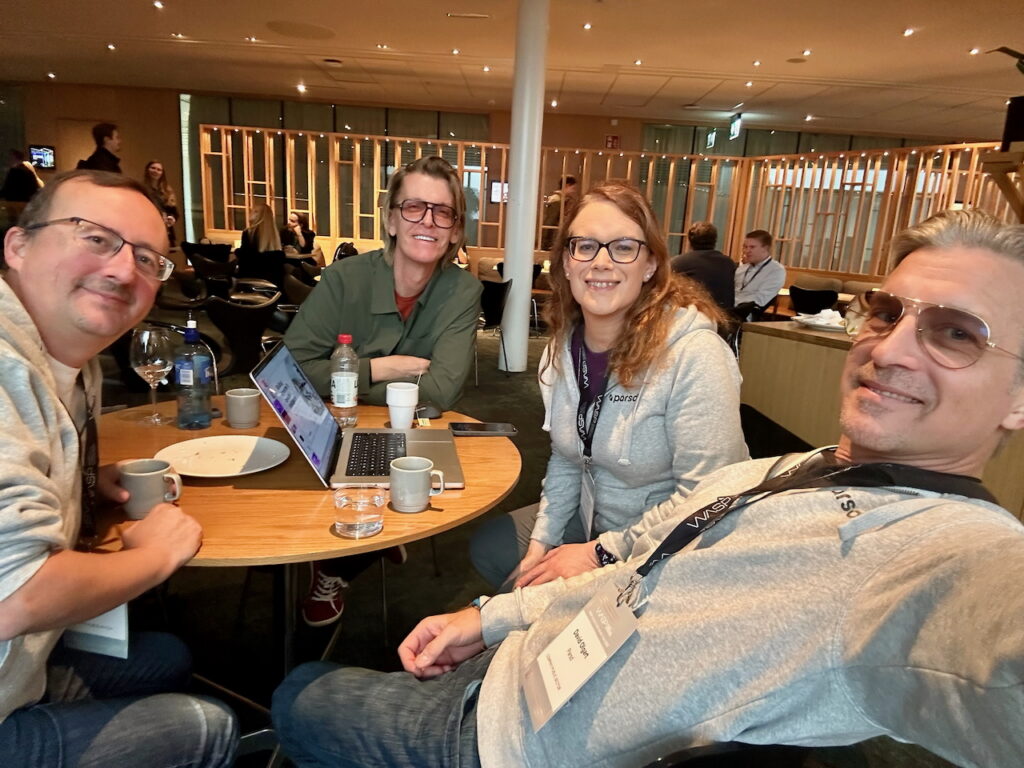
Our amazing team at the Wallenberg Academia & Industry Days 2025
A year of building got me closer to the core of our sometimes invisible profession
At the beginning of this new year, I find myself looking back at what we’ve built at Parsd in 2025. We shipped quite a bit – new text extraction capabilities, moved to Pinecone for our vector database, added draft report generation, implemented electronic ID support, and built out collaboration features.
But the feature list isn’t what matters most. What matters is what we learned about the people we’re building for: the professional thinkers doing critical analytical work that shapes decisions in organizations across sectors.
Professional thinkers are everywhere. But nobody calls them that.
Instead, they’re called consultants, academics, researchers, analysts, advisors, strategists, administrators, planners, experts… and more.
Even if they work in different fields, they all have something important in common: A key part of their job is to gather and make sense of large amounts of information. And, based on their research and analysis, share their findings and insights with others.
The Infrastructure Work That Enables Everything Else
Some of the most important work we did this year was less visible to users but fundamental to everything else. We rebuilt our text extraction pipeline to better handle complex documents, including multi-column layouts in PDFs. We also moved to Pinecone as our vector database, significantly improving search and retrieval performance.
These aren’t flashy features, but they’re the foundation that makes AI-assisted analysis actually reliable. When I wrote about trust in AI-powered analysis, I emphasized that grounding AI in quality data is essential. You can’t ground analysis in data you can’t extract properly.
“By having users bring their own data, we can provide ‘grounding’ for the answers AI provides.”
Better text extraction and retrieval means the AI works with more accurate representations of what analysts have collected. It’s technical work, but it matters for trust.
The Collaboration Insight
Earlier this year, I wrote about the invisible profession of analysts and how their work often disappears into the decisions it supports. That understanding shaped our thinking about collaboration features.
We built project sharing, project chat sharing, and knowledge object sharing. The project chat sharing might seem like a detail, but it reflects something important about analytical work: insights often emerge in the dialogue, not just in the final report.
“Being able to work together to make sense of the world and create fact-based insights – that’s what collaboration is really about.”
When teams can share not just their conclusions but their analytical conversations – the questions they asked, the contradictions they uncovered, the synthesis that emerged – they’re sharing the actual intellectual work.
Trust Through Identity
One update that might not seem significant was our support for electronic ID login with BankID. In my article about building trust in AI-powered analysis, I argued that authenticated provenance isn’t just about security – it’s about accountability.
When I put my name on analysis as a military intelligence officer, that signature meant something. Electronic ID creates that same foundation in the digital realm.
Here in Sweden, with BankID adoption at 99.9% for working-age adults, this is actually the most frictionless way to log in. But more importantly, it establishes where insights can be scrutinized, where professional reputations matter.
Getting Closer to the Actual Workflow
Throughout 2025, a pattern emerged in our user conversations: they appreciated our tools, but needed help understanding how they fit into their complete workflow.
This led to our draft report generation feature. Based on research questions and selected project chats, we can now provide formatted Word documents with proper references.
“Just providing users with a toolbox is not always enough. Finding out what tools to use when and helping them integrate them into their way of working is important.”
This realization became even clearer in the era of agentic AI. Trying to automate a process isn’t enough – it has to connect to the collaboration and review process required for important decisions.
Visualizing these user workflows has been interesting, and they’ll inform our roadmap in 2026. That’s why we felt it was important to build more complete support for the whole workflow.
A simpler way to import data is in testing
We’re also testing a Chrome plugin that lets you import web pages, documents and audio files directly to Parsd. It can even detect if you’re trying to upload something that already exists in your knowledge base.
This addresses something I wrote about in my article on friction points – the hesitation analysts feel before importing documents, the duplicate fears, the manual overhead of tracking what they’ve already collected.
“We need to remove the friction in capturing different types of data and eliminate unnecessary hesitation.”
It’s not ready yet, but early testing suggests it could change how people work with the platform.
What We Didn’t Ship
I had thought we would ship more support for Parsd-provided datasets – both source metadata and access to actual content. Users request it, but they also really value having control over what content the AI uses to generate answers.
This tension taught me something: there’s a difference between making things easier and making them better. Sometimes the “friction” of curating your own dataset is actually important – it’s the professional diligence that separates trusted insights from quick answers.
We’ll continue working on this in 2026, but always with user control and transparency at the center.
Looking Ahead to 2026
The features we’re developing for early 2026 – improved translation for domain-specific texts and audience-targeted draft reports – reflect an evolving understanding.
“We need to fit outputs to both their target audience and defined structure, getting closer to what users can actually adapt to their workflows and requirements.”
This connects back to something I wrote about analytical methods: analysis doesn’t happen in a vacuum. It needs to be connected to organizational goals and delivered in formats that suit specific audiences.
The Bigger Picture
As I reflect on 2025, I keep coming back to the themes I’ve explored in my articles this year:
From my piece on advancing analytical methods: the methodology matters, the tools matter, and they need to develop together.
From my article on friction points: we need to support the actual nature of analysis work – messy, iterative, collaborative – not just the idealized linear process.
From my piece on AI trust: when your name is on the line, good enough isn’t good enough.
And from my reflections on the EBU/BBC study: not all AI tools are created equal, and for professional work, the distinction between consumer and professional tools matters more than ever.
What 2025 Taught Me
Building for professional thinkers is humbling work. These are people doing critical analysis that shapes policy, strategy, and important decisions.
This year taught me that features alone don’t solve problems – understanding the workflow, the collaboration patterns, the psychological barriers, and the organizational context matters just as much as the technology.
It reinforced that we’re in the early phases of figuring out how AI augments human intelligence for serious analytical work. We need to increase not just productivity but also quality and relevance of insights.
And it reminded me why this work matters. In a world where AI assistant responses often contain significant errors, where disinformation threatens democratic discourse – empowering professional thinkers with proper tools matters.
Together Into 2026
I’m grateful to our users who’ve shared their workflows, their frustrations, and their needs with us. Your patience as we figure this out together is invaluable.
I’m proud of our team, who’ve worked hard to ship meaningful improvements while staying true to our values of trust, transparency, and methodological rigor. We are building something important here, and I love that we are having a great time together doing it. Thank you so much!
And I’m excited about 2026. We have a clearer picture now of what professional thinkers need to create trusted insights that matter. Let’s continue this journey together.
What were your biggest learnings about analytical work in 2025? What challenges are you hoping to solve in 2026?
Alexandra Kafka Larsson is the CEO and Co-founder of Parsd, a digital research platform that helps analysts create trusted insights. She previously served as a military intelligence officer in the Swedish Air Force and has over 30 years of experience in intelligence systems and methods.
Related articles:
- The Invisible Profession That Shapes Our World – https://www.linkedin.com/pulse/invisible-profession-shapes-our-world-alexandra-kafka-larsson-xe9xf?trackingId=tpqQN7jCRVahURYSIJtXYg%3D%3D&lipi=urn%3Ali%3Apage%3Ad_flagship3_profile_view_base_recent_activity_content_view%3B%2FmzP81GORnaovWYW93TRZg%3D%3D
- The Never-Ending Quest: 30 Years of Advancing Analytical Methods – https://www.linkedin.com/pulse/never-ending-quest-30-years-advancing-analytical-kafka-larsson-78xpf?trackingId=tpqQN7jCRVahURYSIJtXYg%3D%3D&lipi=urn%3Ali%3Apage%3Ad_flagship3_profile_view_base_recent_activity_content_view%3B%2FmzP81GORnaovWYW93TRZg%3D%3D
- The Hidden Friction Points That Sabotage Strategic Analysis – https://www.linkedin.com/pulse/hidden-friction-points-sabotage-strategic-analysis-kafka-larsson-fyqqf?trackingId=tpqQN7jCRVahURYSIJtXYg%3D%3D&lipi=urn%3Ali%3Apage%3Ad_flagship3_profile_view_base_recent_activity_content_view%3B%2FmzP81GORnaovWYW93TRZg%3D%3D
- When Your Name Is on the Line: Building Trust in AI-Powered Analysis – https://www.linkedin.com/pulse/when-your-name-line-building-trust-ai-powered-alexandra-kafka-larsson-2vggf?trackingId=tpqQN7jCRVahURYSIJtXYg%3D%3D&lipi=urn%3Ali%3Apage%3Ad_flagship3_profile_view_base_recent_activity_content_view%3B%2FmzP81GORnaovWYW93TRZg%3D%3D
- When 45% Wrong Isn’t Good Enough: Lessons from the EBU/BBC AI Study – https://www.linkedin.com/pulse/when-45-wrong-isnt-good-enough-lessons-from-ebubbc-ai-kafka-larsson-lsfgf?trackingId=tpqQN7jCRVahURYSIJtXYg%3D%3D&lipi=urn%3Ali%3Apage%3Ad_flagship3_profile_view_base_recent_activity_content_view%3B%2FmzP81GORnaovWYW93TRZg%3D%3D
