
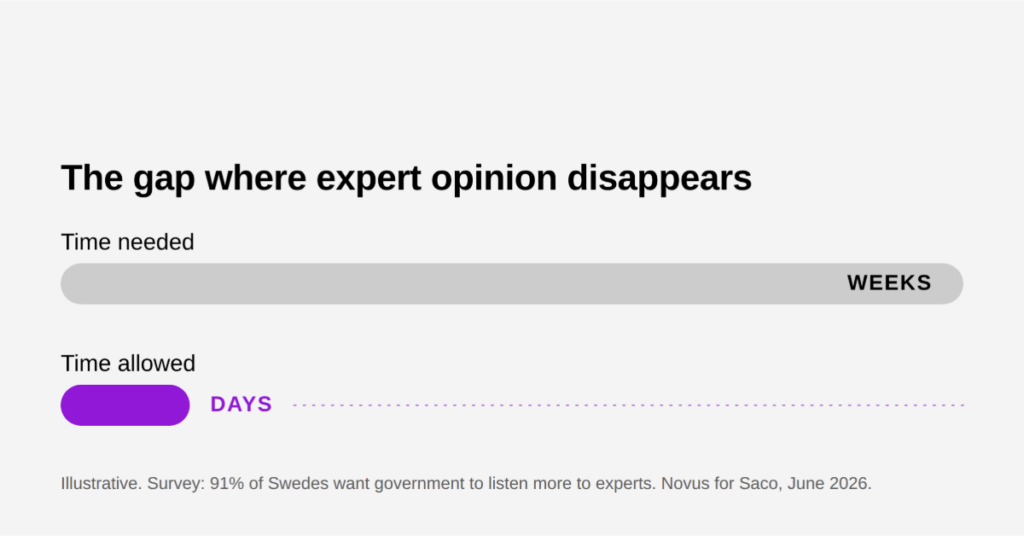
The public isn’t the obstacle. Time is.
We’ve spent a decade telling ourselves a story about the death of facts. Post-truth. Alternative facts. The end of expertise.
There’s been plenty to feed it, too. Scientific advice has been pushed aside at the highest levels of government in more than one country, research budgets have been cut for reasons that had nothing to do with the research, and experts have been described as an interest group with an agenda rather than people whose job is to find out what’s true.
So it was genuinely encouraging to see Saco’s recent Novus survey showing that 97 per cent of Swedes want political debate built on facts and knowledge. 91 per cent think the government should listen more to experts when decisions are made. 87 per cent would like to see the parties agree across the aisle on issues that outlast a single electoral term.
The picture is similar across the globe. In January 2025, Nature Human Behaviour published a study of 71,922 people across 68 countries, home to around 80 per cent of the world’s population. Trust in scientists came out moderately high, with not one country showing low overall trust. Three quarters agreed that scientific methods are the best way we have of establishing what’s true. And most people said they wanted scientists more involved in society and policymaking, not less.
That is not a post-truth public. That’s a public asking, politely and repeatedly, to be governed by people who’ve done their homework.
Which ought to change the question we’re asking.
If we all want it, what’s in the way?
We’ve put a lot of energy into the demand side of this problem. Fact-checking, science communication, media literacy, campaigns to rebuild trust. All worth doing. But the numbers suggest the public was never the bottleneck.
In my experience the answer is far less dramatic than the post-truth story, and much more fixable. It’s time.
Consider what it actually takes to answer one real question well. Say you’re asked on a Monday whether a particular intervention works, and the decision is being made on Thursday.
Doing that properly means finding the relevant research, which is scattered across journals, agency reports, registry data and grey literature that no single search will surface.
It means reading enough of each study to know whether it holds up. Sorting the well-designed from the underpowered. Checking whether the population studied resembles the one you’re deciding about. Working out which of two contradictory findings has been superseded. Reconciling three sources that disagree, and understanding why they disagree.
And, on top of this, keeping track of where every number came from, so the advice can still be defended in a year’s time when somebody challenges it.
That’s weeks of work. And it’s not even the exciting part. It’s just the assembly work that has to happen before the thinking and analysis can start.
More often than not, decisions can’t wait that long. So the gap gets closed some other way.
What happens when the time isn’t there
It almost never looks like an expert being shut out. It looks like three much quieter things.
The expert answers a narrower question. Not the one that was asked, but the one that can be answered honestly by Thursday. The advice is sound as far as it goes, and it goes a shorter distance than anyone needed.
Or the expert offers a professional opinion where they would much rather have offered evidence. Experienced people have good instincts, and good instincts are worth something. They’re just not the thing the 91 per cent were asking for.
Or the expert stays out of it. And the space doesn’t stay empty. It gets filled by whoever is most comfortable being certain in public, and comfort with certainty is not a proxy for knowing things.
Nobody chooses any of this. It’s simply what happens when the calendar wins, over and over, in thousands of small decisions that nobody logs as a failure of evidence.
Speaking up costs time too
The same squeeze shows up in public debate.
Ask people with real expertise why they don’t write more, comment more, or take the interview. You’ll rarely hear that they have nothing to say. You’ll hear that a well-made argument takes a couple of days they haven’t got, that the nuance disappears in the edit, and that the inbox afterwards can be unpleasant enough to think twice next time.
Every specialist who concludes it isn’t worth the effort leaves a gap in the same way. And it compounds, because the fewer careful voices there are in a debate, the more exposed the next one feels.
Employers can do something about this rather easily. Treat public contribution as part of the job rather than something done in the evenings, and back people when the reaction comes. That costs very little and it changes who is willing to speak.
Let experts say what they don’t know
There’s an awkward part to this, and it belongs in the piece.
When expert advice is communicated as certainty and then has to change, as good advice does when the evidence changes, it looks to the public like the experts were wrong. Or worse, that they were being managed.
People are far more forgiving of “this is our best estimate, here’s the range, and here’s what would make us revise it” than we tend to assume. Uncertainty expressed honestly builds credibility. Certainty that gets quietly revised burns it, and it hands the floor to whoever sounds most sure. Which is the dynamic we’re trying to get out of.
Ask decision-makers what they used
We hold experts to a standard of evidence. We rarely hold decision-makers to a standard of use.
It’s a fair question to put to any significant decision, in government or in a company. What did you look at? Who did you ask? What did they say, and where did you take a different view, and why? Not to catch anyone out, but because a decision whose reasoning can be inspected is one people can live with even when they’d have chosen differently.
That, I suspect, is closer to what the 91 per cent actually want. Not obedience to experts. Decisions with visible workings.
What’s at stake either way
The cost of getting this wrong is easy to underestimate, because it arrives slowly. Bad decisions rarely announce themselves. They turn up years later as a policy that didn’t work, a system that has to be rebuilt, or a generation of researchers who went somewhere else. When Nature polled its readers in the United States in March 2025, three quarters of the 1,600-plus scientists who responded said they were considering leaving the country. That’s a self-selecting sample and should be read as a temperature check rather than a national statistic, but it’s a striking temperature.
The upside is just as easy to miss, because it looks like ordinary life. In 1997, the year the Swedish parliament adopted Vision Zero, 541 people died on Swedish roads. Last year the figure was 208, with considerably more traffic on those roads. That came out of an approach built by engineers and researchers rather than by intuition, and we take it completely for granted now. Which is what a well-made decision looks like from thirty years away. Invisible.
Sofia Rydgren Stale put it neatly in Saco’s release: Sweden became successful by combining political decisiveness with knowledge and reflection. That’s the formula, and it’s worth protecting.
The encouraging bit
We’re not fighting public opinion here. Nine out of ten Swedes, and a clear majority across 68 countries, are already asking for this. That’s an unusually strong hand to be holding.
So the work isn’t convincing anyone that knowledge matters. It’s giving the people who produce knowledge the time, the tools and the conditions to get it in front of the people making decisions, while the decision is still open.
What would make the biggest difference in your world? More time, better access, being asked earlier, or knowing your employer has your back when you speak up? I’d like to hear it, because the majority has done its part. The rest is on us.
Alexandra Kafka Larsson is the CEO and co-founder of Parsd, an AI startup that provides a smart digital library for professional thinkers. She previously served as a military intelligence officer in the Swedish Air Force and has over 20 years of experience in intelligence systems and methods. She also has a Bachelor in Political Science from the University of Lund in Sweden
Sources: Saco/Novus survey, press release 10 June 2026 · slowpolitics.se · Cologna et al., “Trust in scientists and their role in society across 68 countries”, Nature Human Behaviour, January 2025 · Nature reader poll of US scientists, March 2025 · Transportstyrelsen, road fatality statistics
